

SeedHome: A living longevity sanctuary, designed with nature and guided by the wisdom of biology, laws of physics and timeless geometry.

SEEDHOME MANIFESTO
Within a single seed lives the promise of a New Earth.
When the human spirit awakens in Love, Awareness, and Integrity, we remember who we truly are—part of the sacred web of life.
Through regenerative living, honoring Air, Fire, Soil, Water, and All Living Beings, and guided by Sacred Design, humanity walks gently toward its Highest Path.
Plant the Seed.
Align with Soul.
Grow the New Earth.
Roger D. Jones
A Home in Harmony with Earth, guided by Love, Regenerative Living
and Sacred Design in service to the Highest Good.”
SeedHome: A living longevity sanctuary and a bio shelter organism, that gains it's strength through geometry, designed with guidance from biology and laws of physics.
A Healthy Home is a living structure. Designed for the highest good where human vitality, ecological regeneration, and emotional harmony are woven together through natural materials. With intelligent design, and alignment woven into nature’s rhythms.
This is the foundation of SeedHome: The Living Nest.
A home that breathes — built through curvilinear, compression-based forms that honour strength through geometry.
SeedHome is born from cymatics — the consciousness of the dwelling sung into existence.
Its geometry reflects the shape of music, expressing the understanding that homes are not inert objects, but living environments — spaces with presence, memory, and soul.
Crafted with the timeless guidance of Vastu, Feng Shui, and Sacred Geometry, each space is intuitively aligned to support well-being, balance, and emotional peace. This is architecture designed not only for shelter, but for harmony between the human body, the land, and the unseen rhythms of life.
Water becomes life here — through regenerative greywater and blackwater wetlands that cleanse, nourish, and restore, creating a living ecosystem around the home. These systems transform necessity into regeneration, turning waste into fertility, beauty and fresh air.
Fabricated with care and brought to life through decentralised local manufacturing, SeedHome allows rapid deployment on the land — without losing soul, beauty, or connection to place.
We are changing the way humans inhabit Earth.
More than a structure, SeedHome is a living bio-shelter — a nurturing space where families grow, women feel held, and life unfolds in harmony with nature.
Homes are alive.
They carry the shape of music.
They hold the consciousness of those who dwell within them.


SEEDHOME — An Investment Overview
We invite you to co-invest in SEEDHOME, a biomorphic compression-only prefab home designed for rapid, low-cost, and regenerative construction.
At its core, SEEDHOME is a compression-only shell structure which is inspired by nature’s efficiency where the load bearing capacities come from the correct geometry, significantly reducing material use while maintaining exceptional strength.
SEEDHOME combines passive heating and cooling by utilising ingenious inventions of our ancestors as well as the latest innovations.
Homes are designed to be mass-produced through decentralized micro 3D printing facilities, allowing communities to manufacture housing affordably and sustainably locally rather than relying on centralized factories.
SEEDHOME is developed at the forefront of the seventh technological paradigm — an era where technology integrates seamlessly with living systems. In this model, architecture becomes responsive, efficient, and aligned with natural processes, supporting both environmental resilience and human wellbeing.

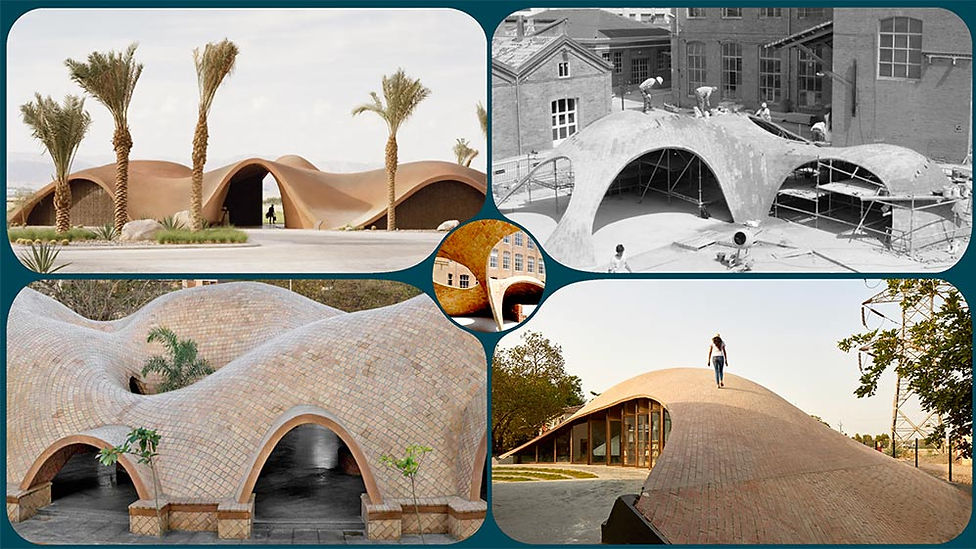
the pictures on the right show a method of construction that we'll be implementing for rapid deployment
WHAT IT IS
A prefabricated compression-only home system designed for global scalability through decentralized robotic fabrication.
Each unit is based on a patented structural blueprint that can be executed using robotic arms equipped with specialized 3D printing or moulding heads, enabling fast, precise, and repeatable construction across diverse regions.
REVENUE MODEL
Revenue is generated through the licensing and deployment of the SEEDHOME fabrication system.
Income streams include:
• Sale of tested and patented blueprint licenses to manufacture homes
• Manufacturing and supply of custom robotic printer heads
• Training, certification, and technical support for local fabrication hubs
• Selling produced homes in our production facility
This model enables scalable global growth while maintaining local adaptability and cost efficiency.

R&D of compression only structures by Philip Block at ETH
WHY NOW?
The global housing crisis, rising material costs, and severe labor shortages are forcing the construction industry to evolve. At the same time, robotic fabrication, advanced materials, and decentralized manufacturing have reached maturity.
SEEDHOME emerges at this precise moment — offering a scalable, material-efficient housing system designed for the realities of the 21st century.
Our advantage lies in using compression-only structures with local molds, allowing us to avoid costly, large-scale 3D printing rail systems. This means we can print molds anywhere, using locally available materials, making SEEDHOME not only efficient but adaptable to any community. This is how we scale affordably, quickly, and globally—right from the ground up.
-
To allow homeowners to afford a home without the burden of long-term debt.
-
Inside a SeedHome, one feels aligned with sacred geometric proportions—reflecting the human body—naturally connecting them to their higher purpose, inspiring expression of talents and destiny—reminding them why they are here.
-
SeedHome is a model of co-creating a home in harmony with Nature.
-
It captures, stores, filters, delivers clean water, and upcycles all wastewater to nourish gardens and grow food.
-
It grants freedom to live where you choose, without utility bills.
-
It offers health, vitality, and longevity—a home that feels like being held in Nature’s womb.
-
It protects us from the growing presence of electromagnetic radiation.
-
To gently remind the person living in SeedHome—designed in harmony with the Creator’s image—that they, too, are inherently connected to the divine, as a child of that creative force.
-
It ensures a comfortable year-round temperature by harnessing passive heating and cooling technologies.


some of the previous passively heated and cooled designs by Alosha
A TEAM CAPABLE OF MAKING THIS REAL
Our team is equipped not only to build this prototype — but to scale it into a repeatable construction system.
We use compression-only shell geometry, inspired by natural structural principles and advanced by pioneers such as Antoni Gaudí.
This method reduces material use by up to 70% while increasing structural strength and longevity.
This creates a clear advantage in cost, efficiency, and durability.
There are currently 2 active partners, who are diving the project: Alosha Lynov and Roger D. Jones as well as a dozen backend freelancers who are aligned with our vision
A Union of Vision + Bio-Architecture Mastery
Alosha
-
Bio-Architect
-
Founder of Bio-Veda Academy
-
Over 30 years designing and setting up curvilinear & bionic large scale sculptures for events (up to 90000 sq feet at a time) and building regenerative, self-sufficient bio-architecture systems
-
Trained over 3,500 students across 5 continents through live and online training
-
Deep expertise in: Earthship systems, natural building (adobe, SuperAdobe), passive climate design, Vastu and bio geometry
-
Merged Living BioShelter (SeedHome) with nature and 7th technological paradigm
Alësha brings the systems, the engineering, and the proven ability to build what others only imagine a rare fusion of visionary design and real-world execution. From the very first sketches as a child to large-scale bio-architectural projects, he has woven geometry, ecology, and human spirit into every project.
Roger
-
Roger D. Jones is a co-creator, designer, and steward of spaces devoted to beauty, community, and regenerative living.
-
He is the co-creator of Elegancia Designs, a long-standing collaborative enterprise that has designed, co-designed, and manufactured thousands of decorative accessories in partnership with skilled Mexican artisans—honoring tradition while bringing handcrafted design to a global audience.
-
Roger is also the co-creator and designer of the boutique hotel Casa Angelitos in San Miguel de Allende, which he currently operates. Under his care, Casa Angelitos has become a beloved sanctuary known for its warmth, authenticity, and heartfelt sense of family—and ranks among the top boutique hotels in Mexico ( pictures below /// click for web page )
-
He also served for several years as a director at Árbol de Vida Waldorf School, contributing to a holistic educational environment rooted in creativity, human development, and community values
-
In addition, Roger maintains a close alliance with Vía Orgánica, where he serves as a longtime supporter and trusted ally. As a devoted volunteer and advocate, he offers his time, guidance, and presence in support of its regenerative mission.
-
Across all his work, Roger is guided by a commitment to the highest good—bringing people together, supporting artisans, and cultivating spaces that nourish both the human spirit and the living Earth.


Rapid Deployment Capability
Once our digital fabrication and 3D-printing facility is operational, each home can be built on site in 7–10 days.
This enables:
-
Faster build cycles
-
Reduced labor and transport costs
-
High precision and repeatability
-
Scalable production capacity
-
Deployment in remote or natural locations
What typically takes months can be delivered in days.
A Multidisciplinary Team
Our collective brings together the core expertise required to execute and scale:
-
Compression-shell builders
-
Biomimetic and regenerative designers
-
Engineers and digital fabrication specialists
-
Living-material and ecological systems experts
-
Entrepreneurs focused on production scaling
This combination of design, engineering, and execution capacity positions us to move from prototype to scalable production.
Built to Scale
This first villa is the prototype for a scalable system, not a one-off structure.
It will validate:
-
Construction speed
-
Material efficiency
-
Performance systems
-
Replication workflows
From this foundation, we expand into rapid-deployment living architecture at scale.
If you're building an investor deck, the next section I strongly recommend is:
"MARKET OPPORTUNITY — WHY NOW"
That’s where investor attention really locks in.

Designed for Longevity & Vitality
1. Feng Shui:
-
Enhances harmonious chi flow
-
Improves wealth and prosperity
-
Boosts interpersonal relationships
-
Reduces stress and anxiety
2. Vastu Architecture:
-
Balances the five elements (earth, water, fire, air, space)
-
Improves health and well-being
-
Enhances mental clarity
-
Reduces stress
3. Sacred Geometry:
-
Creates a sense of harmony and balance
-
Invokes a feeling of unity and wholeness
-
Reduces mental fatigue
-
Elevates spiritual well-being
4. BioGeometry: (Dr Ibrahim Karim)
-
Neutralizes harmful electromagnetic radiation
-
Boosts energy levels
-
Improves immune system function
-
Supports long-term vitality
5. Cymatics: (Dr Masaru Emoto)
-
Embeds positive vibrational patterns (e.g., love)
-
Creates a sense of calm and positivity
-
Aligns subconscious mind with affirming frequencies
-
Supports mental and emotional healing
Build-In Constructed Wetland as per the Earthship Botanical Cell
Fresh, Oxygen-Rich Air
• Continuous supply of purified oxygen from plants
• Reduces indoor CO2 levels, improving focus and well-being
Natural Air Filtration
• Plants filter out pollutants and dust
• Removes toxins, improving overall indoor air quality
Moist, Hydrated Air
• Adds humidity, crucial in dry, high-desert climates
• Reduces dryness, benefiting skin, respiratory health, and comfort
Calming Scents
• Rose Geraniums, lavenders and other aromatic plants provide soothing, natural fragrances
• Enhances mood and creates a peaceful atmosphere
Aesthetic and Biophilic Design
• Brings nature inside, fostering a sense of calm and connection to nature
• Improves mental clarity by integrating greenery into daily life
Sustainable Water Cycle
• The constructed wetland recycles water naturally
• Reduces water consumption, enhancing sustainability

previous detailed blueprints by Alosha
ENGINEERING FOUNDATIONS & TECHNICAL READINESS
The SeedHome system is developed as a buildable, structurally grounded solution, not only an architectural vision.
Our design process focuses on the real technical performance of the structure, including:
-
Structural load paths and compression-based force distribution
-
Structural shell thickness and material performance
-
Foundation and support node engineering
-
Waterproofing, drainage, and moisture protection
-
Thermal envelope and insulation strategy
-
Natural ventilation and environmental comfort
-
Passive heating and cooling
-
grey and back water treatment through botanical cells
-
Step-by-step construction methodology
These elements ensure that SeedHome structures are safe, durable, and feasible to construct in real-world conditions.
INTEGRATED DESIGN METHODOLOGY
SeedHome development follows a three-layer methodology:
Vision — Biomimetic seed-based geometry and organic architectural form
Design Logic — Catenary geometry, radial compression systems, and parametric modeling
Engineering Reality — Structural calculations, reinforcement design, material testing, and assembly sequencing
This integrated workflow ensures design feasibility and structural reliability.
CORE TECHNICAL COMPONENTS
The SeedHome system includes detailed development of:
-
Structural shell optimization
-
Central compression crown design
-
Structural support and foundation systems
-
Waterproofing and drainage infrastructure
-
Thermal mass and insulation performance
These components form the technical backbone of the system.
PROFESSIONAL ENGINEERING SUPPORT
SeedHome is being developed with the collaboration of qualified specialists, including:
-
Structural engineers
-
Architects
-
Materials and fabrication specialists
-
Soil and foundation experts
-
Environmental systems consultants
This collaborative approach ensures engineering integrity, safety, and build readiness.

ESTIMATED EARLY MARKET ENTRY FOCUS
Primary Entry Regions
SeedHome’s initial market focus targets regions where land ownership, regenerative living, and alternative construction adoption are already growing.
Key early-entry regions include:
-
North America — United States and Mexico
(Strong off-grid, permaculture, and retreat development activity) -
Southern Europe — Spain, Portugal, Greece
(Growing eco-village movement and favorable climates) -
Australia & New Zealand
(High demand for climate-resilient and off-grid housing)
These regions offer the highest probability of early adoption, demonstration projects, and rapid market validation.
Primary Entry Customer Segment
Initial deployment focuses on:
-
Private landowners planning ecological homes
-
Retreat and wellness center developers
-
Eco-village founders and regenerative communities
-
Influencers
These groups:
-
Control land
-
Have decision-making authority
-
Are actively seeking alternative housing solutions
-
Are prepared to build within short timelines
-
Large following
This enables faster pilot projects and real-world proof of concept.
Strategic Entry Advantage
SeedHome’s early market strategy prioritizes:
-
Owner-driven projects (faster decisions)
-
Demonstration builds (visible proof of performance)
-
Experience-based architecture (high referral potential)


AN EXPERIENCE THAT ENERGISES LIFE
Revitalising Living BioShelter is a regenerative sanctuary.
It collects rainfall and structures its own living water.
Up to 50% of water usage is saved, thanks to a sensory, year-round winter garden of herbs and flowers, which filters shower water for toilet flushing.
Sunlight refracts through a prism, filling the space with a rainbow spectrum.
The home protects its inhabitants from electromagnetic radiation through BioGeometry, creating a healing space for body, mind, and soul.
The body is enveloped in comfort, attuned to temperature, humidity, fresh air, and hormonal balance.
The mind finds clarity in sacred geometry, fractal patterns, and paintings.
The soul awakens in a power space, creating a portal, aligned by Vastu — where windows, doors, and even rooms are placed precisely to harmonize energy flows.
A TEAM CAPABLE OF MAKING THIS REAL (flesh out)
Our team is uniquely equipped not only to build but to scale this project.
Using shell structures that work purely in compression, we reduce material usage by 70%.
Once we launch our 3D printer production, each home will be built on site in just 7 to 10 days.
We are a collective of master bionic builders, nature-inspired designers, living material specialists, and next-generation entrepreneurs.
WHERE WE ARE GOING
We stand at the threshold of the 7th technological paradigm — an era where technology synchronizes with life and ecology, not separate from it.
Russian researchers V.E. Lepsky and I.A. Prokhorov define this era as the age of cognitive technologies and living space technologies.
Today, architecture is no longer just construction.
It is a profound interaction between human consciousness, technology, and the biosphere.
Within this paradigm, a radical shift is happening:
nature is no longer seen as a resource to be exploited — it is recognized as the greatest engineer.
Nature creates shells stronger than ceramics.
Spiders spin silk fibers five times stronger than steel.
In this noospheric, ecologically oriented order, technologies are aimed at harmony with the biosphere, and global systems are managed through collective consciousness.
As Neri Oxman says, in nature, design, engineering, and production are one.
We no longer separate them.
In this new paradigm, we apply genetic algorithms inspired by evolution.
Forms evolve like organisms — constantly adapting and optimizing.
Quantum co-design and artificial intelligence allow us to model complex biomimetic (nature-aligned) structures as living forms that respond to their environment as if they were growing.
The Bio-Architect in this paradigm is not merely a designer.
ARCHITECTURE AS LIVING INTELLIGENCE
Through biofeedback, sensors, and adaptive materials, buildings no longer simply house the dwellers — they enter into interaction with them.
Architecture becomes a continuation of nature — not a rupture, but a bridge.
Technology ceases to be the antagonist of life — it becomes its next chapter.
Our Revitalising Living BioShelter grows, breathes, and evolves together with us.
THE VISION OF THE BIO-ARCHITECT
The Bio-Architect of the future is not a conventional designer
They do not merely construct buildings — they breathe life into architecture, making it a dynamic extension of human vitality.
Integrating the 7th technological paradigm, the Bio-Architect unites the wisdom of nature — biomimicry and living ecosystems — becoming a co-creator together with nature and advanced technologies such as AI and digital fabrication.
They work with natural materials — clay, timber, bio-based composites — ensuring breathability and adaptability in every element.
Their forms emerge from the laws of nature
Just as a tree shapes itself according to its environment, so too does the building grow from its context — enabling passive heating and cooling without conventional methods
The Bio-Architect serves as a bridge between human consciousness, living ecosystems, and intelligent technologies.
They do not impose form — they facilitate process
Through genetic algorithms, structural solutions evolve, refined to their specific environment while minimizing resources.
AI, quantum co-design, and bio 3D printing become tools — not to replace nature, but to amplify it.
Neurointerfaces allow the architect to sense how space influences human emotion and cognition, ensuring that every corner of the home responds with care.
In essence, the Bio-Architect does not think in static buildings, but in living systems.
They design not only for the body — but for the inner harmony of the human spirit.
For them, architecture is a dialogue with life.
It is a way of restoring human beings into balance with the natural world — with themselves, and with their purpose.

TOWARD LIVING PLANETARY HABITAT
We are entering an era where intelligence itself becomes a building material.
Not only steel, stone, or timber will shape the habitats of the future—but knowledge, simulation, and adaptive systems. In this emerging world, artificial intelligence becomes a collaborator in design, helping humanity move beyond static construction toward living architecture—settlements that behave less like machines and more like ecosystems.
Traditional buildings are rigid objects, frozen in time.
Bio-architecture, by contrast, seeks to create environments that breathe, adapt, and evolve. With the arrival of powerful AI, this shift accelerates dramatically. We gain the ability to simulate entire ecosystems in real time, shape buildings that respond to climate, and design materials at the biological level. Instead of building a house once and leaving it unchanged, we begin to cultivate habitats that learn.
This transformation extends beyond individual buildings into the scale of landscapes and regions. Future settlements will not be isolated structures imposed upon nature—they will be woven into the living fabric of land, water, and atmosphere. Water cycles will be integrated into terrain, soils will be regenerated rather than depleted, and food forests will grow alongside homes. Communities will synchronize with natural rhythms rather than struggle against them.
This marks the transition from an industrial civilization to an ecological civilization.
Perhaps the most revolutionary shift lies in biology itself. As intelligence accelerates discovery, materials and systems once imagined only in nature will become part of architecture. Structures may begin to resemble coral reefs, termite mounds, or forest ecosystems—not symbolically, but functionally. Walls may repair themselves. Plants may regulate temperature. Buildings may exchange nutrients with the soil beneath them. In time, architecture will evolve into biotic infrastructure, participating directly in the cycles of life.
At planetary scale, this intelligence allows humanity to adapt to climate and environmental change with foresight rather than reaction. Instead of fragile megacities, distributed networks of resilient micro-settlements may emerge—self-sufficient, regenerative, and deeply connected to their landscapes. These habitats will harvest sunlight, cycle water, grow food, restore soil, and produce minimal waste. Each one will be a node in a larger planetary web of life.
In such environments, human health becomes a design principle. Spaces will be shaped not only for shelter, but for vitality—aligned with circadian rhythms, tuned to sound and light, and designed to support emotional and social well-being. Architecture will not merely protect life; it will actively enhance it.
At the same time, the role of the architect will transform. No longer working alone, designers will collaborate with vast networks of intelligence, running thousands of simulations and receiving instant feedback on structure, materials, and ecological impact. The architect becomes less a builder of objects and more a conductor of intelligence, guiding flows of knowledge toward life-supporting form.
This shift also carries responsibility. Without wisdom, powerful tools can create fragile systems, monocultures, or centralized control over natural processes. Technology alone is not enough. Ethical awareness, ecological sensitivity, and cultural diversity must evolve alongside innovation. Intelligence must be guided not only by efficiency, but by care.
What emerges from this convergence is the possibility of a new kind of civilization—a planetary habitat civilization. A world in which settlements regenerate landscapes rather than degrade them, technology enhances biodiversity rather than replacing it, and humanity lives as an active participant within Earth’s living systems.
Imagine landscapes dotted with bio-architectural communities—clusters of homes that breathe with the seasons, that harvest energy from sunlight, that cleanse and reuse water, that nurture both families and ecosystems. Each settlement self-reliant, yet interconnected through networks of shared intelligence. Not centralized control, but distributed harmony.
This is the deeper message behind the rise of intelligent systems:
not domination of nature, but partnership with it.
The future of civilization will not be built in the old sense of the word.
It will be cultivated, grown, and guided.
The next civilization will not be constructed — it will be grown.
And the role of architects, designers, and visionaries will be clear:
To guide intelligence toward life.
